Clifton Lewis: Helping Those with MD Live the Good Life

Clifton was born and raised in Nanticoke, Pennsylvania, and currently resides in Goodyear, Arizona. 

Growing up, Clifton was an athlete and his passion was playing basketball, but when he was in college, he started to notice his right arm getting weaker. Two years after seeing a doctor and physical therapist, he was diagnosed with limb-girdle muscular dystrophy. 

“For the first four or five years after the diagnosis, I didn’t need to use any mobility device but when I started falling more often, I knew it was time to get a scooter,” Clifton explained. Clifton uses his Jazzy® Zero Turn to maintain his independence. He loves the suspension and the comfortable, smooth ride and comments that it’s one of the coolest scooters he’s ever seen in styling and functionality. “It turns in a complete circle and that is a huge benefit especially indoors. No other 4-wheel scooter can do that,” Clifton said. He also loves having four wheels because it gives him the stability and safety he needs when transferring or getting up from the scooter. 

Clifton is an avid traveler. “My scooter has opened so many new doors for me. From New York City to Hawaii and all over the U.S., my scooter has made traveling so much better and way more fun,” he said. Clifton is passionate about helping families with muscular dystrophy. He founded the Clifton R. Lewis Good Life Foundation in 2010. He has helped almost 100 families affected by muscular dystrophy all over the country. “We grant special equipment like Pride scooters and power chairs and any other mobility device that you could think of,” Clifton said. 

In addition to donations, the foundation also makes dreams come true for kids with muscular dystrophy. From visiting Disney to meeting NFL players, the organization has fulfilled the wishes of many children. When he isn’t traveling or planning events for the organization, Clifton enjoys spending as much time as he can with his two young kids, who also love his scooter. They especially love visiting and playing in the community pool and splash pad together. He sets an example for his kids by showing them that anything is possible, even if it needs to be done a little differently. “Even though I have a disability I try and show them that anything is possible. I’m showing my kids on a daily basis to never, ever give up!” Clifton said. Clifton is highly involved with many muscular dystrophy related organizations, all of which he considers leaders in helping families and raising awareness for muscular dystrophy, not stopping until they find a cure. “My friend and mentor told me once: Just keep pushing. Be the very best version of yourself every single day,” Clifton said. Learn more about the incredible work he’s doing through his foundation at crlgoodlife.org.

Mobility Scooter vs. Power Wheelchair

When considering purchasing a scooter or a power chair, you might have a lot of questions. There are many differences between motorized scooters and electric wheelchairs. By understanding these distinctions, you will be able to choose which mobility product is right for your needs. One of the biggest differences between a scooter and a power chair is how they are operated. Mobility scooters are equipped with a tiller and handle bars, as opposed to a power wheelchair, which is operated using a joystick. Your range of mobility in operating a device may indicate whether a scooter or power chair is best for you. Another difference is the number of wheels they have. An electric scooter typically has three or four wheels, whereas an electric wheelchair typically has six wheels or more. Most power chairs have two large drive wheels and four smaller wheels called casters for added stability. Power wheelchairs come standard with captain’s style seating and there may be optional seating available, such as a solid seat pan or a Synergy® seat. The Jazzy Select 6 power wheelchair offers a few seating options to choose from. Scooters usually come with standard vinyl seating, although the seat can be adjusted and may be able to swivel, such as the Victory® 10 3-wheel scooter.   When it comes to comfort, electric wheelchairs are equipped with a height-adjustable foot platform that can flip up when not in use. Leg room on a scooter can vary depending on the type of mobility scooter chosen. A three-wheel scooter offers more leg room for taller individuals, while a four-wheel scooter is equipped with a broader wheelbase to ensure even weight distribution for stability. 

To determine whether you need a motorized wheelchair or an electric scooter, ask yourself where the mobility product will be used. While many motorized scooters and electric wheelchairs can be used both indoors and out, power chairs offer more maneuverability indoors. With its front-wheel drive design, the Jazzy Select motorized wheelchair is extremely compact and maneuverable. In contrast, many scooters are more rugged and designed for outdoor use, such as the Revo™ 2.0 electric scooter, which is equipped with suspension components for navigating varied terrain. Another point to consider when choosing between a scooter or a power chair is your method of paying for the mobility device. Medicare may cover a portion of the cost of a power mobility device for use in your home, providing it is shown to be medically necessary.  You need to schedule a face-to-face examination with your doctor to discuss your needs for a mobility device.  During the exam, your physician must first consider the use of a cane, walker or manual wheelchair, before considering a scooter or power chair. A face-to-face exam and a special prescription from your doctor is required before Medicare helps pay for your mobility scooter or electric wheelchair. If you have private insurance, it’s important to speak to your insurance representative regarding requirements for reimbursement.

Are Scooter Batteries Covered by Insurance?

If you use a mobility scooter, you are probably wondering if the batteries for your scooter are covered by insurance. When your scooter needs new batteries, we recommend contacting your insurance to find out what may be covered. If your electric scooter is prescribed by a doctor, your scooter may be considered medical equipment. Medicare Part B may cover a portion of the cost of a power mobility device, such as a motorized scooter, if it is medically necessary. Medicare requires a face-to-face examination with your physician prior to writing a prescription for a power mobility device. During your exam, your physician must first consider the use of cane, walker, and manual wheelchair before considering a scooter. If your physician feels that your mobility needs must be resolved with an electric scooter, this would need to be documented in your medical records. A physical therapist or occupational therapist may also conduct an additional assessment if your physician feels it would help in determining whether the motorized scooter is necessary. Medicare Part B can also cover replacement batteries for a scooter if your current batteries are no longer working properly. If you qualify for the mobility scooter, you qualify for replacement batteries. You can visit Medicare.gov or call 1-800-MEDICARE (1-800-633-4227) for further details. If you don’t have Medicare Part B, you can contact your private insurance company to find out if electric scooter batteries are covered. Simply dial the number listed on your insurance card and speak to a representative. Also, your doctor’s office may be able to confirm whether your insurance will cover the cost of new scooter batteries. If your private insurance won’t cover the cost of new motorized scooter batteries, there are still options available. Many Pride providers that sell mobility scooter batteries accept credit cards, cash, money orders or offer financing options. Over hundreds of Pride providers participate with CareCredit, a credit card that allows you to pay for medical equipment and services over time. The payment plan is based on your budget. There are also special promotional financing options available upon credit approval. Contact your provider today to find out how you can fill out an application or visit carecredit.com for more information.

How Can I Get My Mobility Scooter Repaired?

If you use your motorized scooter every day and put a lot of miles on it, eventually, repairs may be needed. Whether it’s a simple repair or something more complicated, your provider can help! Regular service checks are vital to keeping your scooter running smoothly. Motorized scooters must be serviced by an authorized Pride provider. Our providers are trained to perform diagnostic testing and repairs. Give your provider a call and schedule an appointment if you need service for your mobility scooter. We do not recommend consumers perform their own mobility scooter repairs. This is for safety reasons. If you are unsure who your provider is, contact our Consumer Call Center. Our team of representatives is available Monday-Friday, 8:30am – 5:00pm, to assist you. Call 800-800-4258 or email at info@pridemobility.com. If your electric scooter is prescribed by a doctor, your scooter may be considered medical equipment. Medicare Part B may cover a portion of the cost of a power mobility device, such as a motorized scooter, if it is medically necessary. Medicare requires a face-to-face examination with your physician prior to writing a prescription for a power mobility device. During your exam, your physician must first consider the use of cane, walker, and manual wheelchair before considering a motorized scooter. If your physician feels that your mobility needs must be resolved with an electric scooter, this needs to be documented in your medical records. A physical therapist or occupational therapist may also conduct an additional assessment if your physician feels it would help in determining whether the motorized scooter is necessary. Medicare Part B may also cover scooter repairs. If you qualify for the mobility scooter, you qualify for any necessary repairs. You can visit Medicare.gov or call 1-800-MEDICARE (1-800-633-4227) for further details. If you have private insurance, you can contact your insurer to find out if they cover electric scooter repairs. Call the number listed on your insurance card and speak to a representative. If your insurance doesn’t cover motorized scooter repairs and you need help paying for the repairs, there are options available. Many Pride providers accept credit cards, cash or money orders for their services. They may also offer financing options. Over hundreds of Pride providers participate with CareCredit, a credit card that allows you to pay for medical equipment and services over time. The payment plan is based on your budget. There are also special promotional financing options available upon credit approval. Contact your provider today to find out how you can fill out an application or visit carecredit.com for more information.

How to Choose a Mobility Scooter

You’ve decided to purchase a mobility scooter. This is the first step to enhancing your mobility. Yet, there are so many different types of scooters out there. How do you know which electric scooter is right for you? When choosing the right mobility scooter, it’s important to ask yourself several questions.

  • Do I want a 3-wheel scooter or a 4-wheel scooter?
  • How will I use my motorized scooter?
  • How fast do I want my power scooter to go?
  • How far do I want to travel with my mobility scooter?

First, it’s important to understand the major differences between 3-wheel and 4-wheel electric scooters. A 3-wheel scooter has many benefits, such as a sharper turning radius and more leg room for taller individuals. Three-wheel power scooters are also better suited for smooth, indoor surfaces. In contrast, 4-wheel motorized scooters provide a broader and more stable wheelbase, ensuring better weight distribution. Four-wheel scooters are also well-matched for outdoor driving. The second thing to anticipate when choosing a mobility product is how you will use your scooter. If you need a scooter mainly for inside your home, you want a device that offers a tighter turning radius, such as the Zero Turn 8 or the Go-Go Elite Traveller®. These scooters fit through door frames and maneuver around corners easily. If you prefer to use a scooter outdoors, you need a product that is more rugged and can handle varied terrain, while still offering comfort and stability. The Revo™ 2.0 features suspension components that absorb shock, giving you a smoother and more enjoyable ride. To some, the speed of a scooter is important, as well as safety features. The Raptor cruises up to 14 mph and is equipped with a regenerative braking system. If you are concerned about visibility, then look for a motorized scooter that offers LED lighting. This ensures your safety when driving your scooter in low-light environments. Lastly, the range of a scooter can also play a huge role in choosing the product that is right for you. Many scooters are battery-powered. Consider how far you want to drive your mobility scooter on one charge. Depending on the kind of batteries used, the Victory® 10.2 can travel up to 13 miles in a single charge. Still not sure which scooter is a good fit? Search for a local dealer near you and take a Pride® scooter for a test drive today!

Research and Development

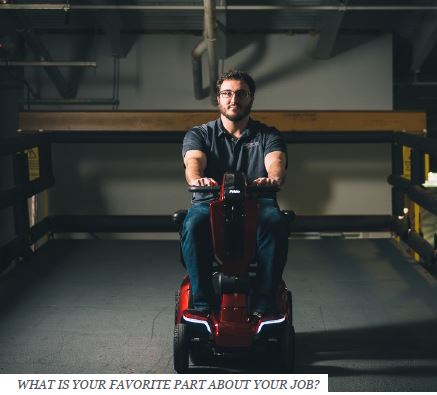
Where does it all start? When you see a car, a phone, a piece of furniture, or even a mobility device, do you ever wonder how the idea came about? We sat down with Matthew, Manager, Design Engineer, and Vinnie, Design Engineer II, to learn more about the product design journey.

Matt started his career at Pride Mobility about twelve years ago in the Quantum R&D department and Vinnie joined the Pride R&D department over 4 years ago. While the design process is similar, the application is very different and needs to be considered. Matt explained that Quantum products require more specific configurations that are tailor-made to each consumer.

When we think of research and development, we think of a department that is shrouded in mystery. That’s not the case here at Pride Mobility! Matt and Vinnie are two members of a robust team that have been doing field research to gain valuable feedback directly from our consumers, particularly at trade shows like the Abilities Expo. While attending the shows, they have opportunities to speak to providers as well! Gaining feedback from both groups gives Matt and Vinnie a well-rounded view of exactly what the end user is looking for in a mobility device. It also happens to be their favorite part about the expos! Once feedback is received, Matt and Vinnie bring it to the rest of the team to discuss and see how they can work the information into future product designs. Many accessories and features are a direct result of feedback obtained from our customer base. The saying, “it takes a village” really applies to product development. Matt and Vinnie work hand in hand with many other internal departments to communicate product innovations.

“Facing new challenges and upgrading our consumers’ experience by making our products lighter, faster, better!” – Matthew

They both agree that their favorite part of the job is watching ideas come to life. They love to develop more advanced products to fit the ever-changing landscape of the mobility industry, while making sure that quality and comfort are at the forefront of every product that is created.


The person responsible for our design, innovation, and technology goals is really YOU.”


We live in a world dominated by technology and automation. When we asked Matt and Vinnie where they feel the mobility world is heading, they unanimously agreed that travel mobility products are the future. Pushing the limits of mobility devices is always on their minds. When a product is designed, one of the many goals is to ensure that people can truly live their best life and go off the beaten path.

Now it’s time to dive into their personalities! Everyone has a favorite, whether you admit it or not. We asked Matt and Vinnie what their favorite products are. Matt loves the Zero Turn 10 scooter. He really enjoys the innovative design and seeing style meet functionality. For Vinnie, his favorite is the Jazzy Air® 2. He loves receiving consumer feedback at the expos regarding this life-elevating power chair!

The next time you see a Pride Mobility product, know that the person responsible for our design, innovation, and technology goals is really YOU.

We love hearing from you! Stop by one of our booths at an expo near you, send us an email, chat with one of our friendly and knowledgeable customer service reps, or give us a call!

“I am passionate about how our products are used and how they allow people to regain their independence. Anytime I see someone using our product, it makes my day.” – Vinnie

PRIDE MOBILITY LAUNCHES REPOSITIONED ZERO TURN SERIES

EXETER, PA – Pride Mobility announced today a brand repositioning, creating the Zero Turn Series. Formerly known as the Jazzy Zero Turn Scooter and ZT10 Scooter, these products have been renamed for clarity to the Zero Turn 8 Scooter and the Zero Turn 10 Scooter. The two Zero Turn scooters now make up the Zero Turn Series of scooters, with plans of new products to join in the future. “As our sales, marketing, and research and development departments looked at how these products were evolving, we realized having a series would better show the consistencies of the two units,” said Renae Storie, Vice President of Pride Mobility. “We want to have an extremely defined line between scooters and power chairs and feel it’s important to distinguish the Zero Turn Series products as scooters. However, make no mistake that these scooters are the same products you’ve come to love, but with a fresh spin.” Adam Fuller, Director of Pride Research and Development, noted the importance of the Zero Turn mechanism, which separates the series from other scooters offered by Pride and competitors. “The Zero Turn Series of scooters are driven by dual motors that allow the outer drive wheel to turn forward as the inner drive wheel turns in reverse, providing an exceptional turning radius,” Fuller said. “The iTurn Technology™ can provide up to a 30 percent better turning radius than a similar sized four-wheel scooter. In addition, the dual motors work together to provide a substantial amount of power and traction over a typical scooter.” For more information on the Zero Turn Series, please click here. Pride Mobility Products® Corporation is the world’s leading designer and manufacturer of mobility products including Jazzy® Power Chairs, Go-Go® Travel Mobility, Pride Mobility® Scooters, and Pride® Power Lift Recliners. The Pride® family of companies also includes Quantum Rehab®, a leader in complex rehab power chairs, as well as Stealth Products®, the foremost manufacturer of positioning components. Headquartered in Exeter, Pennsylvania, Pride also has operations in Las Vegas, Mississippi, Florida, Australia, Canada, China, France, Italy, the Netherlands, New Zealand and the United Kingdom. Please visit pridemobility.com.

10th Annual Disability Mentoring Day

DURYEA, PA – Pride Mobility Products® and Quantum Rehab® offered approximately 20 Luzerne Intermediate Unit students with disabilities an opportunity to be mentored by career professionals in various fields during its 10th Annual Disability Mentoring Day (DMD) on Thursday, Oct. 10 at the company’s Duryea facility. 

DMD is designed to bring students with disabilities into the workplace where they can learn about various career paths. Through Pride and Quantum’s 10th Annual DMD event, participants had the opportunity to meet with professionals to learn the typical job responsibilities and the necessary knowledge and skills needed for a specific vocation. Careers in research and development, sales, technical service and production were highlighted. The students were able to tour the production area and see a state-of-the-art test lab. 

“We look forward to this day every year because we want to teach young people like yourself about business,” said Scott Meuser, Chairman and CEO of Pride and Quantum. “Just like in sports, there are different positions available here. Find out what you are interested in. We hope that today gives you better insight into what you want to do when you get older.” 

Many of the students enjoyed being up close and personal to see how power wheelchairs are made and learned about the vast number of careers at the company, from an assembler to a sales representative. 

“I liked learning how they make the wheelchairs and learning that just because you are in a wheelchair, doesn’t mean you can’t do things,” said Richard Breton. 

Jacklyn Rose Chmiola shared a similar sentiment. 

“I liked everything including how people with disabilities were making wheelchairs better and giving their feedback. I learned there are a lot of opportunities even if you have a disability,” Chmiola said. 

DMD originated at the White House in 1999 with less than three dozen local individuals participating. Now hosted by the American Association of People with Disabilities, the nation’s largest cross-disability membership organization, DMD has evolved significantly to encompass participation in all 50 states and many countries around the world. To find out more about DMD, visit http://www.aapd.com/disability-mentoring-day/

Pride Mobility Products® Corporation is the world’s leading designer and manufacturer of mobility products. The Pride family of companies also includes Quantum Rehab®, a leader in complex rehab power chairs. Founded in Pennsylvania in 1986, with a customer-first philosophy, Pride has grown into a global company with distribution centers throughout the U.S. and subsidiaries around the world.

PRIDE MOBILITY CELEBRATES CHRISTMAS IN JULY

Many families in our local communities are unable to celebrate Christmas as they struggle to provide the basic necessities of food and shelter. In response to this critical need, the employees of Pride Mobility coordinated a donation drive to benefit the Catherine McAuley Center by collecting toys for children who might otherwise never experience the magic of Christmas. “We are grateful beyond words for everyone at Pride Mobility who was a part of this amazing project,” shared Krista Somers, Executive Director of the Catherine McAuley Center. “Thanks to their generosity and thoughtfulness, children in need will be able to share in the joy of the Christmas season.” 

A local nonprofit organization, the Catherine McAuley Center has responded to the needs of homeless women and children in Lackawanna and Luzerne Counties since 1984 by providing housing and supportive services. The Center depends on the support of generous donors like Pride Mobility to sustain their mission and services. Pride Mobility Products Corp. helps thousands of people live their lives to the fullest by creating the best personal mobility products in the world.  Pride’s commitment to show compassion, respect and appreciation for others is demonstrated by giving back to the community in so many different ways. “The generosity of our employees was overwhelming for our Christmas in July toy drive,” said Denise Truesdale, Vice President, Human Resources. “We strive to go above and beyond to show our employees how much we appreciate them knowing they do the same for our customers.  The week-long Christmas in July celebration is now a tradition at Pride and includes festive decorations and attire, plenty of employee giveaways, cookouts and showcasing our employees in our Holiday Video that is filmed throughout the week.  The toy drive benefiting the Catherine McAuley Center children was a great privilege to top off our week of celebration.” To learn how you can make a difference in the life of someone who is homeless, please contact the Catherine McAuley Center at 570-342-1342.

PRIDE MOBILITY PRODUCTS® AND QUANTUM REHAB® EARN BETTER BUSINESS BUREAU® ACCREDITATION

EXETER, PA – Pride Mobility Products® and Quantum Rehab® have recently obtained accreditation by the Better Business Bureau® (BBB) serving metro Washington, D.C. and eastern Pennsylvania.

The BBB is a resource for the public, providing trustworthy, unbiased information about businesses. As a BBB Accredited Business, Pride Mobility Products and Quantum Rehab are dedicated to promoting trust in the mobility products marketplace.

“We are pleased to be a BBB Accredited Business because we value building trust with our consumers,” said Scott Meuser, Chairman and CEO of Pride Mobility Products and Quantum Rehab. “Our BBB Accreditation gives our customers confidence in our commitment to maintaining high ethical standards of conduct.”

BBB Accredited Businesses must adhere to the BBB’s Code of Business Practices, a comprehensive set of policies, procedures and best practices for representing trustworthiness in the marketplace. The code is built on the BBB Standards for Trust, which calls for building trust, embodying integrity, advertising honestly and telling the truth, being transparent, honoring promises, being responsive and safeguarding privacy.

Pride Mobility Products Corporation is the world’s leading designer and manufacturer of mobility products. The Pride family of companies also includes Quantum Rehab, a leader in complex rehab power chairs. Founded in Pennsylvania in 1986, with a customer-first philosophy, Pride has grown into a global company with distribution centers throughout the U.S. and subsidiaries around the world.

For more information, visit our BBB Business Profile at bbb.org.